

Reducing Product Liability Reduction for OEMs Through Embedded AI Safety Solutions
In today’s rapidly evolving industrial landscape, OEMs face increasing pressure to design machines that are not only efficient but inherently safe. Product liability risks are no longer limited to manufacturing defects—they now extend to whether manufacturers implemented the latest available safety technologies.
Failure to meet these expectations can lead to costly legal product liability claims, reputational damage, and loss of market trust.
By embedding AI-powered pedestrian detection systems directly into equipment, OEMs can move from reactive compliance to proactive risk prevention, significantly reducing liability exposure while strengthening their competitive position.
The Growing Risk of Product Liability in Industrial Machinery
Product liability standards are tightening across global markets, particularly in the U.S. and Europe. Regulatory frameworks such as the upcoming EU Machinery Regulation 2027 and functional safety standards like ISO 13849 are redefining OEM responsibilities.
Today, when an accident occurs, investigations go beyond operator error. Courts increasingly ask:
- Could this accident have been prevented with modern technology?
- Did the OEM integrate state-of-the-art safety systems?
- Was pedestrian protection adequately addressed?
If the answer is no, liability risk increases significantly.
This shift means OEMs are no longer judged solely on mechanical reliability—but on their ability to anticipate and prevent human-machine interaction risks.
As seen across industrial environments, many accidents stem from visibility issues, blind spots, or lack of real-time awareness—factors that modern AI systems are specifically designed to address.
Why Embedded AI Safety Is the Best Risk Mitigation Strategy
Traditional safety systems rely heavily on operator behavior, training, or aftermarket retrofits. While useful, these approaches create liability gaps.
Embedded AI safety systems fundamentally change this dynamic.
Instead of reacting to hazards, OEMs can:
- Integrate safety directly into machine design
- Ensure consistent protection across all units
- Eliminate dependency on optional add-ons
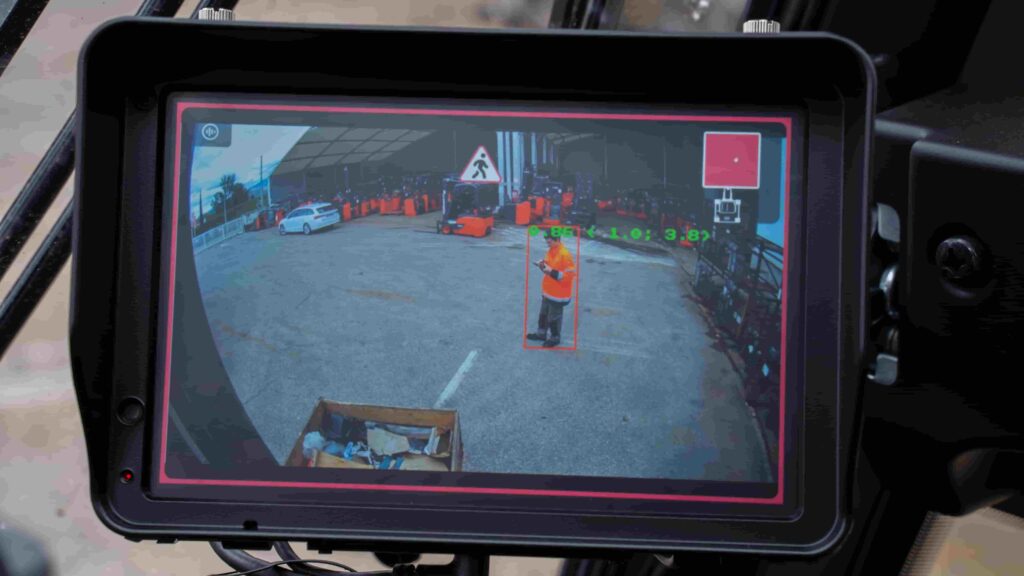
AI-powered pedestrian detection systems continuously monitor the environment and provide real-time alerts only when actual danger is present, reducing both risk and operator overload.
This proactive approach demonstrates:
- Due diligence in design
- Commitment to worker safety
- Alignment with evolving legal expectations
In liability cases, these factors can be decisive in proving that the manufacturer took all reasonable preventive measures.
Understanding “State of the Art” in OEM Safety Design
The concept of “state of the art” plays a critical role in product liability cases. It refers to the highest level of safety technology reasonably available at the time of manufacturing.
OEMs are expected to:
- Stay updated with technological advancements
- Integrate proven safety innovations
- Avoid relying on outdated or insufficient systems
AI-based vision systems now represent this benchmark.
Unlike traditional radar or ultrasonic systems, AI solutions:
- Detect and classify pedestrians in real time
- Distinguish humans from objects
- Adapt to complex and dynamic environments
This level of intelligence is essential in high-risk environments where simple object detection is no longer sufficient.
By integrating AI, OEMs can clearly demonstrate that their machines meet modern safety expectations, significantly reducing legal exposure.
How Blaxtair’s Embedded AI Reduces OEM Legal Exposure
Blaxtair’s AI-powered pedestrian detection system is specifically designed to support OEMs in reducing product liability risks through advanced safety integration.
1. Compliance Alignment
Blaxtair supports key safety standards and regulations, including:
- ISO safety frameworks
- ANSI requirements
- EU Machinery Regulation compliance
This ensures OEMs can confidently align their products with global safety expectations.
2. Documentation & Traceability
Comprehensive technical documentation includes:
- Integration guidelines
- Validation reports
- Functional safety data
These documents are critical for demonstrating compliance during audits or legal reviews.
3. Reduced Misuse Risk
Unlike traditional systems, Blaxtair:
- Alerts only when pedestrians are detected
- Minimizes false alarms
- Maintains operator trust and responsiveness
This reduces the risk of system deactivation—a common issue with less advanced technologies.
4. Continuous Updates
AI systems evolve over time. Blaxtair provides:
- Software updates
- Performance improvements
- Ongoing compliance alignment
This ensures machines remain compliant even as regulations evolve.
5. Proven Reliability
With thousands of deployments worldwide, Blaxtair demonstrates:
- Real-world performance
- OEM integration success
- Scalable safety solutions
AI-based collision avoidance systems like Blaxtair have already proven their ability to significantly reduce accidents and improve safety outcomes in industrial environments.
Beyond Liability: Strengthening Brand Trust and Market Value
Reducing liability is only part of the equation.
Embedding AI safety also delivers strong business advantages:
1. Competitive Differentiation
Machines equipped with built-in AI safety stand out in:
- Public tenders
- ESG evaluations
- Safety-driven procurement processes
2. Stronger Customer Trust
Buyers increasingly prioritize safety. OEMs that integrate AI demonstrate:
- Innovation leadership
- Responsibility toward workers
- Long-term reliability
3. Financial Protection
Reducing accidents helps:
- Lower insurance premiums
- Minimize legal costs
- Protect resale value
Workplace incidents are not only safety failures—they are operational and financial disruptions. Preventing them improves both safety and efficiency.
Case Insight: “OEM” Adopts Blaxtair to Strengthen Compliance
A leading construction machinery OEM recently integrated Blaxtair’s embedded AI pedestrian detection system to address increasingly strict safety requirements across European job sites.
Faced with tighter regulatory scrutiny and growing demand for safer equipment, the OEM chose to embed AI safety directly into its machine design rather than rely on optional add-ons.
Outcome:
- Zero incidents involving pedestrians since system deployment
- Accelerated CE certification process due to advanced safety integration
- Increased success in safety-driven procurement tenders
Result:
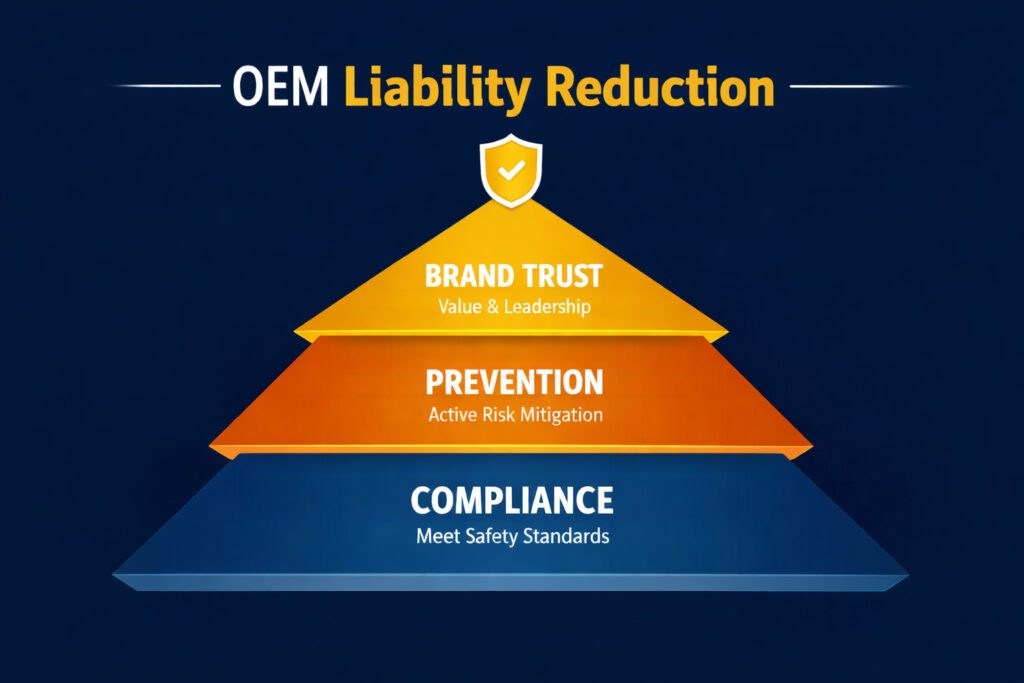
By proactively adopting AI safety, the OEM not only reduced its product liability exposure but also gained a clear competitive advantage in markets where safety is a key purchasing criterion.
This case highlights a critical shift: AI safety is no longer just a feature—it’s a strategic differentiator for OEMs.
How to Integrate AI Safety for Maximum Protection
Successfully reducing product liability requires more than adding a safety feature—it requires a structured integration approach.
Here’s how OEMs can maximize protection with embedded AI safety:
1. Collaborate Early
Engage Blaxtair engineers during the CAD or prototype phase.
Early collaboration ensures:
- Optimal camera placement
- Full coverage of blind zones
- Seamless integration into machine design
2. Validate Performance
Conduct real-world detection trials in actual operating environments.
This allows OEMs to:
- Test detection accuracy in complex conditions
- Evaluate system responsiveness
- Ensure reliability before commercialization
3. Document Integration
Include all safety elements in your conformity files:
- Risk analysis documentation
- Functional safety validation
- Testing and performance reports
These elements are essential for:
- CE marking
- ANSI compliance
- Legal defensibility in case of incidents
A well-documented integration not only supports compliance—it provides critical evidence of due diligence, reducing liability risk.
Conclusion: From Compliance to Competitive Advantage
For OEMs, product liability is no longer just a legal concern—it is a strategic challenge.
Embedding AI-powered safety systems allows manufacturers to:
- Reduce legal exposure
- Meet evolving regulations
- Protect their brand reputation
- Deliver safer, more valuable machines
In a world where safety expectations continue to rise, proactive innovation is the strongest defense.
Ready to reduce your product liability risk and future-proof your machines? Contact Blaxtair today to explore how embedded AI pedestrian detection can enhance your equipment design and protect your business.
FAQs
Does adding Blaxtair shift liability from the OEM to the operator?
No, it creates shared accountability. By integrating Blaxtair, OEMs demonstrate proactive compliance and state-of-the-art safety design, significantly reducing their exposure if an incident occurs.
Can Blaxtair be included in our conformity documentation for CE or ANSI certification?
Yes. Blaxtair provides all necessary documentation and test data for conformity files, helping OEMs demonstrate compliance with ISO and Machinery Regulation standards.
What happens if safety regulations evolve after integration?
Blaxtair’s firmware and software are continuously updated to meet emerging regulatory frameworks, ensuring long-term compliance and helping OEMs stay ahead of liability risks.