

Pre Start Checklist: How to Reduce Equipment Downtime Before Every Shift
Unplanned downtime rarely begins with a major failure—it typically starts with small, preventable issues that go unnoticed before the shift begins. In fast-paced industrial operations, a missed defect can quickly lead to production delays, emergency repairs, and unnecessary maintenance costs.
A structured pre-start checklist helps teams catch problems early and keep vehicles available when they are needed most.
By digitizing inspections on an in-cab screen adapted to any industrial vehicle and creating automatic, traceable records, sites can improve consistency, accelerate maintenance response, and reduce avoidable downtime across the fleet.
Downtime Starts Before the Breakdown
Unplanned downtime rarely begins with a major failure—it typically starts with small issues that go unnoticed: low fluids, worn tires, damaged forks, faulty lights, loose components, or abnormal noises.
When these problems surface mid-shift, the impact is immediate:
- Disrupted workflows
- Delayed production output
- Emergency repairs
- Increased maintenance costs
A consistent pre start checklist is one of the most effective ways to prevent these disruptions—because it identifies risks before the vehicle enters operation.
What a Pre Start Checklist Is and Why It Matters
A pre-start checklist is a structured inspection performed before operating an industrial vehicle. It verifies that critical safety and mechanical points are in acceptable condition for use.
The business impact of consistent pre-start checks
A pre shift inspection checklist supports:
- Earlier defect detection
- Fewer mid-shift stoppages
- Reduced repair urgency and overtime
- Improved maintenance planning
- Better fleet availability
Ultimately, it is one of the simplest ways to reduce equipment downtime while improving operational control.
Why Paper-Based Checks Fail in Real Operations
Many sites still rely on paper checklists—but they often introduce operational risk rather than reducing it.
Common issues include:
- Checks skipped or rushed
- Forms completed after the fact (“pencil-whipping”)
- Lost or unreadable records
- No real-time alerting for maintenance teams
- Limited management visibility
Without traceability, small defects remain unresolved until they cause breakdowns—or worse, accidents.
The Digital Advantage: Pre Start Checklists on a Vehicle-Ready Screen
Digitalizing the pre start checklist improves both execution and oversight.
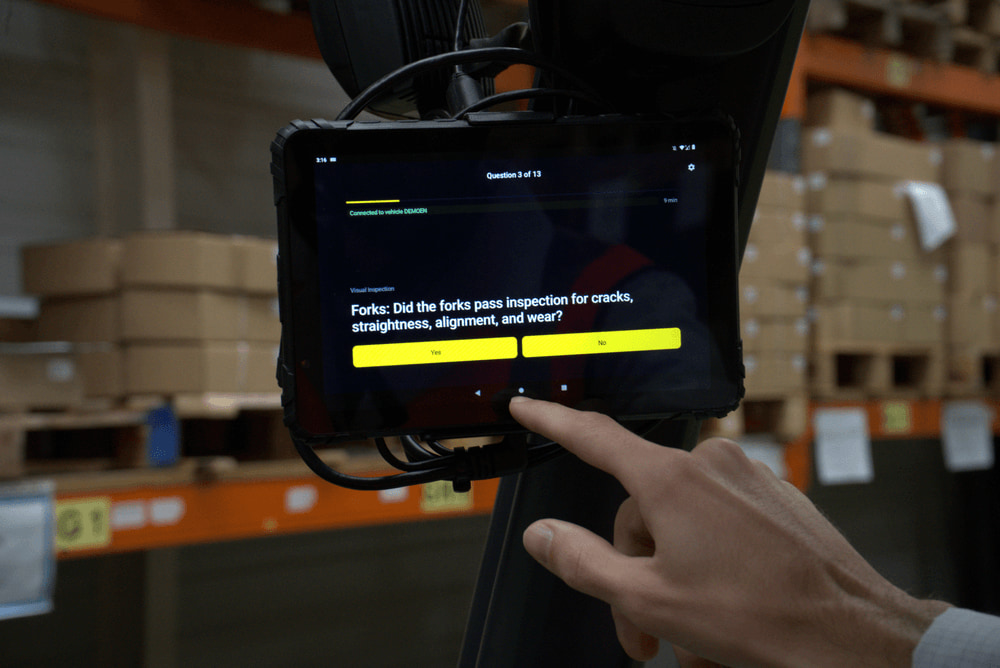
The checklist is displayed on a screen adapted to any industrial vehicle, allowing operators to complete inspections directly from the cab in a standardized interface.
What “vehicle-ready” changes for operators
- No paperwork or manual handling
- Faster completion time
- Consistent inspection quality
- Full accountability (who, when, which vehicle)
This ensures inspections are actually completed—and done correctly.
What to Include in a High-Impact Pre Start Checklist
A high-impact prestart checklist must focus on the most critical safety and mechanical points while remaining fast and easy to complete.
Digital solutions enable customization by vehicle type and environment—ensuring relevance and adoption.
Core checklist categories
- Brakes / steering / controls
- Tires, forks/attachments, chains, hydraulics
- Lights, alarms, horn, safety devices
- Leaks, battery/charge/fuel levels
- Visibility and camera/screen functionality (if applicable)
- Housekeeping (cab condition, mirrors, windows)
These categories ensure that both safety risks and mechanical issues are identified before operation begins.
Customize by vehicle and environment
A pre start checklist should vary depending on:
- Vehicle type (forklift, loader, telehandler, sweeper)
- Indoor vs. outdoor environments
- Industry context (recycling, mining, construction, logistics)
- Regulatory requirements and safety policies
Customization improves efficiency, compliance, and effectiveness.
How Blaxtair Checklist Helps Reduce Equipment Downtime
The impact comes from combining inspection discipline, real-time data, and operational control.
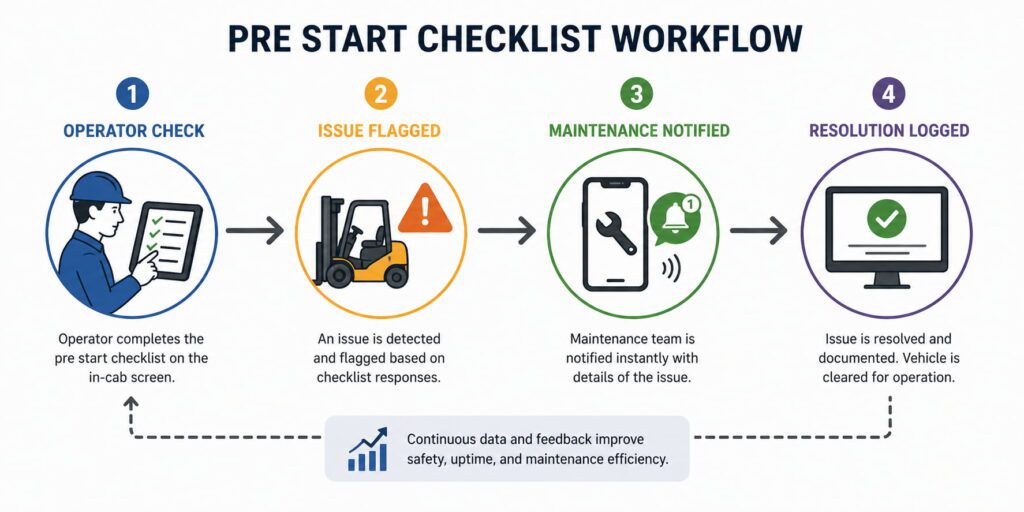
1) Catch defects before they interrupt production
Operators verify critical points before each shift, identifying issues early—before the machine is under load.
2) Trigger maintenance actions immediately
When a defect is reported:
- Alerts are sent instantly
- Maintenance teams can act quickly
- Equipment can be removed from service before failure
3) Create traceability and operational control
Digital records provide:
- Full inspection history
- Compliance documentation
- Actionable insights for continuous improvement
This transforms inspections into a data-driven reliability strategy.
Measuring the ROI: KPIs That Prove the Checklist Is Working
To justify investment, performance must be measurable.
Key KPIs include:
- Downtime hours due to mechanical issues (before vs after)
- Defects detected pre-shift vs mid-shift
- Time-to-notification for maintenance
- Repeated defect frequency per vehicle
- Compliance rate (checks completed per shift / per vehicle)
If you can’t measure it, you can’t improve it—or defend it in audits.
Digital checklists turn inspections into measurable performance drivers.
Implementation Plan: Deploying Pre Start Checklists Across a Fleet
Adoption can be simple, structured, and scalable.
Step-by-step rollout
- Select critical vehicle groups
- Configure checklist templates by vehicle type
- Define defect severity rules (inform vs restrict start)
- Train operators and maintenance teams
- Track KPIs and optimize monthly
Multi-site scaling
Once standardized, companies can deploy across sites with:
- Consistent governance
- Centralized reporting
- Replicable best practices
Best Practices for Maximizing Impact
- Keep checklists short and relevant
- Standardize across similar assets
- Digitize for traceability
- Integrate with maintenance workflows
- Continuously improve using data
Conclusion
A pre start checklist is one of the most effective tools for preventing downtime before it happens. By moving from paper-based processes to digital, in-cab inspections, companies gain consistency, visibility, and control over their fleet condition.
The result is simple but powerful: fewer breakdowns, faster maintenance response, and more reliable operations—shift after shift.
Reduce Downtime Before It Starts
Downtime doesn’t begin with failure—it begins with missed signals.
A digital pre start checklist helps you detect issues earlier, act faster, and keep equipment running.
Request a demo today to see how Blaxtair can help you reduce equipment downtime and improve fleet reliability.
FAQs
What is a pre start checklist?
A pre start checklist is a structured inspection completed before operating an industrial vehicle to confirm critical safety and mechanical points are in acceptable condition for use.
How does a pre start checklist reduce equipment downtime?
A pre start checklist reduces equipment downtime by catching small defects before the vehicle enters production, enabling earlier maintenance action and preventing mid-shift failures that cause stoppages and delays.
Can a pre start checklist prevent a vehicle from being used if a defect is found?
A pre start checklist can prevent a vehicle from being used when configured with start restriction rules, ensuring that critical defects are addressed before the equipment returns to operation.