

AI vs Radar and Tag Systems: The New Standard for Industrial Collision Avoidance
In high-risk industrial environments—like warehouses, quarries, construction sites, and mines—protecting pedestrians around forklifts and heavy machinery is a critical challenge.
For years, companies have relied on radar-based sensors and tag systems to prevent collisions. But today, a new generation of technology is redefining what’s possible.
After more than 16 years of field experience shared during a MODEX 2026 conference by Blaxtair’s CEO and founder, Franck Gayraud, one conclusion stands out:
AI-based vision systems are not just an improvement—they are a true alternative to traditional radar and tag-based safety systems.
In this article, we explain why—and how to choose the right solution for your operations.
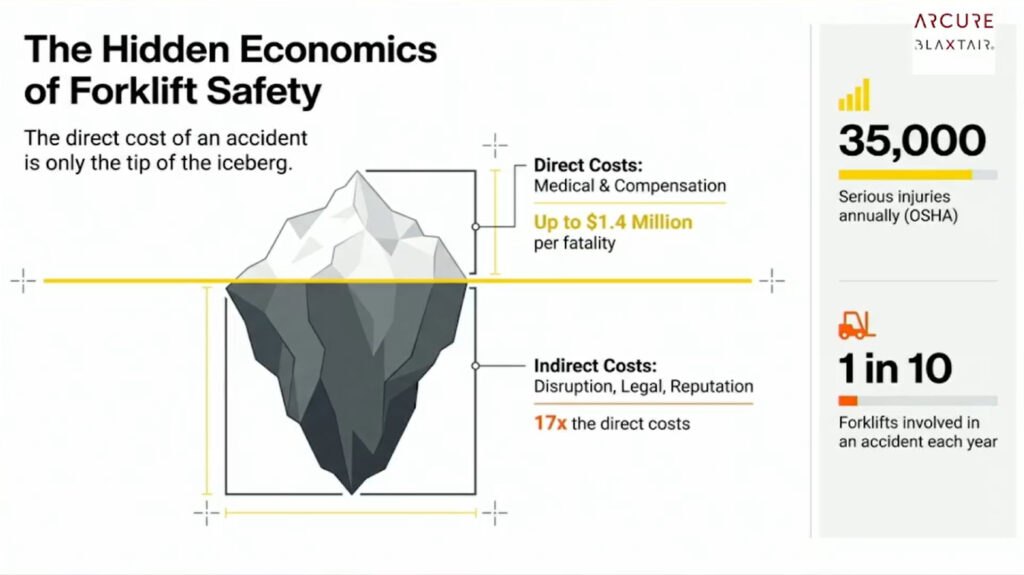
Understanding Collision Avoidance in Industrial Environments
Industrial safety systems must operate in environments that are:
- Dynamic
- Cluttered
- Human-driven
Unlike autonomous systems, forklifts are operated by humans who remain fully responsible for safety. This means technology must:
- Increase awareness
- Avoid distraction
- Deliver only relevant alerts
This is where many traditional systems fall short.
A key concept is alarm fatigue:
- Too many alerts → operators ignore them
- Irrelevant alerts → trust is lost
- Lost trust → system is rejected
The goal is simple: alert only when there is real danger.
Radar-Based Systems: Reliable but Blind to Context
Radar systems (including microwave technologies) detect objects using radio waves.
Strengths
- Works in harsh conditions (dust, fog, rain)
- Long detection range
- Proven durability
Limitations
- Cannot distinguish humans from objects
- Generates frequent unnecessary alarms
- No understanding of collision risk
In real environments, radar detects everything:
- Walls
- Pallets
- Machines
This leads to constant alerts—quickly ignored by operators.
Tag-Based Systems: A Structured but Fragile Approach
Tag systems rely on wearable devices carried by workers.
Strengths
- Identifies tagged personnel clearly
- Eliminates confusion with objects
- Works well in controlled environments
Limitations
- Requires 100% compliance from workers
- Adds human dependency to a safety system
- Cannot detect untagged individuals
- Localization is often not precise enough
In industries like mining, tags are widely used because environments are tightly controlled. But in most operations:
- Workers forget or damage tags
- Visitors are not equipped
- Contractors may not comply
Even more critical:
A system designed to reduce human risk should not depend on human behavior.
Key takeaway:
Tag systems control identification—but not reality.
AI-Based Vision Systems: A True Alternative to Radar and Tags
AI-powered collision avoidance systems fundamentally change the approach.
Instead of detecting signals or relying on wearables, they:
- See the environment
- Recognize humans
- Understand risk in real time
Using cameras and deep learning, AI systems:
- Detect pedestrians—even partially hidden
- Distinguish humans from objects
- Trigger alerts only when there is real danger
👉 Learn more about how AI collision avoidance works:
Why AI Replaces Traditional Systems
AI eliminates the key limitations of older technologies:
| Limitation | Radar | Tags | AI |
|---|---|---|---|
| Human vs object distinction | ❌ | ✅ | ✅ |
| Requires human compliance | ❌ | ❌ | ❌ |
| Works with untagged people | ✅ | ❌ | ✅ |
| False alarms | High | Medium | Very low |
| Localization accuracy | Low | Medium | High |
AI combines the advantages of both systems—without their weaknesses.
The Critical Factor: False Alarms Kill Safety
One of the strongest messages from field experience:
A safety system that creates too many false alarms becomes dangerous.
False alarms include:
- Detecting non-existent pedestrians
- Detecting pedestrians outside risk zones
Consequences:
- Reduced operator attention
- System distrust
- System deactivation
From real-world benchmarks:
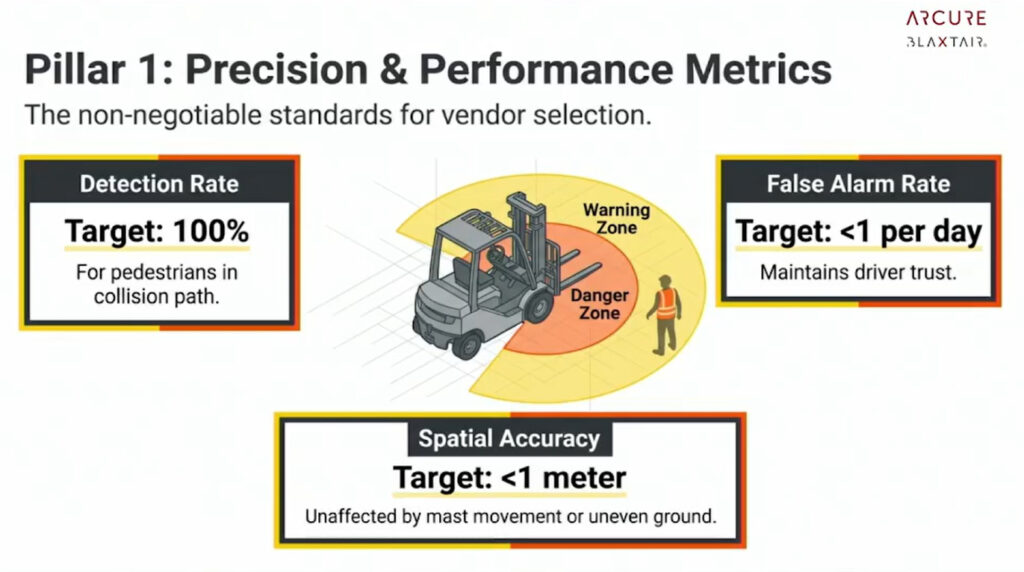
- 1 false alarm per shift → already problematic
- Frequent alarms → system becomes useless
AI systems are designed specifically to avoid this.
Precision Matters: Defining the Right Danger Zone
Detection alone is not enough—location matters.
Best practice:
- 15–20 feet detection range
- Slightly wider than the vehicle
Too large → constant alerts
Too small → insufficient reaction time
AI systems provide precise localization (~1 meter accuracy), ensuring alerts are relevant.
Beyond Detection: Why Connectivity Maximizes ROI
Modern AI systems go further by integrating:
- Detection logs
- Images of events
- Safety dashboards
This enables:
- Incident analysis
- Behavioral improvements
- Continuous safety optimization
Data brings knowledge—and knowledge brings control.
Connected systems deliver significantly higher ROI than standalone detection tools.
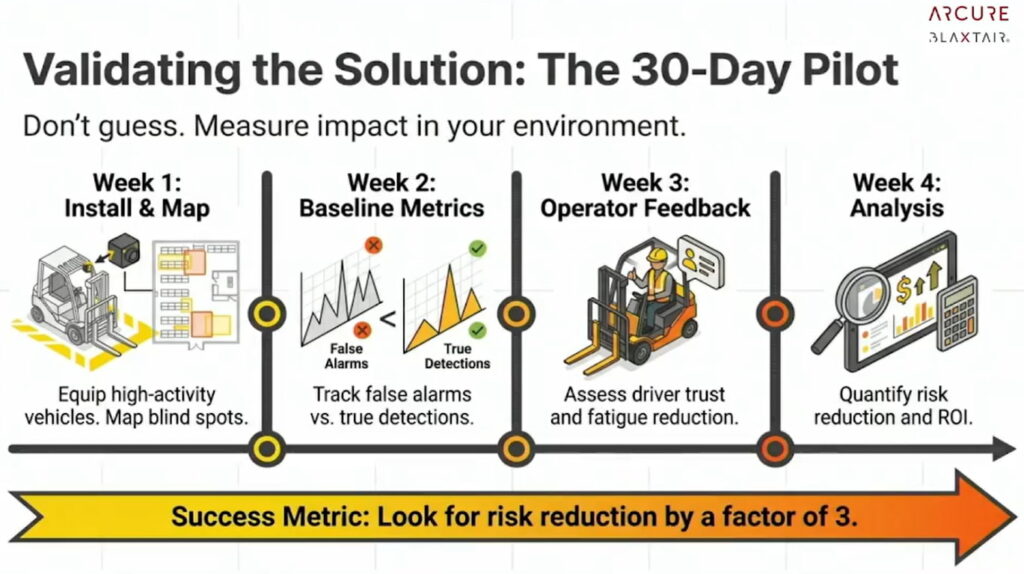
How to Evaluate AI as an Alternative (30-Day Pilot)
Week 1: Setup
Digital checklists turn inspections into measurable performance drivers.
Week 2: Performance
- Detection accuracy
- False alarm rate
👉 More than 1 false alarm/day = reject
Week 3: Operator Adoption
- Trust
- Usability
Week 4: Safety Impact
- Behavior change
- Risk reduction
Use Cases: Where AI Clearly Outperforms Radar and Tags
Warehouses
- High pedestrian density
- Dynamic layouts
Manufacturing
- Mixed traffic
Mining
- Tags commonly used—but AI improves detection and precision
Construction
- Unpredictable environments
Benefits of Choosing AI Over Traditional Systems
1. No Dependency on Workers
No tags required.
2. Minimal False Alarms
High operator trust.
3. Real Risk Detection
Alerts only when necessary.
4. Data-Driven Safety
Continuous improvement.
5. Strong ROI
Reduced accidents and downtime.
Buyer’s Guide: When to Choose AI Instead of Radar or Tags
Choose AI if:
- Your environment is dynamic
- You cannot guarantee tag compliance
- False alarms are a concern
- You want measurable safety improvement
Evaluate:
- Detection accuracy
- False alarm rate
- Localization precision
- Connectivity features
- Proven field experience
Conclusion: AI Is Not an Upgrade—It’s a Shift
Radar and tag systems were designed for a different era.
Today’s industrial environments require:
- Context
- Precision
- Reliability
AI-based systems deliver all three.
They are not just better—they are fundamentally different.
By removing dependency on tags and eliminating irrelevant alerts, AI becomes the most effective way to enhance operator awareness and prevent collisions.
👉 Evaluate AI in your own environment with a 30-day pilot
👉 Talk to Blaxtair experts to benchmark your current system against AI performance
FAQs
Is AI replacing radar and tag systems?
Yes. AI is increasingly used as a standalone alternative because it combines detection accuracy with low false alarms and no dependency on wearables.
Why are tag systems not always reliable?
They depend on workers wearing and maintaining tags. If someone is not equipped, they become invisible to the system.
What is the biggest weakness of radar systems?
They cannot distinguish between humans and objects, leading to frequent false alarms.
What makes AI systems more effective?
They recognize human shapes and trigger alerts only when there is real collision risk.
How do I validate an AI system?
Run a 30-day pilot focusing on false alarms, operator trust, and safety impact.