

The Retrofit Guide for Mixed-Brand Machinery Fleets
Industrial fleets are rarely uniform. Most facilities operate a mix of forklifts, loaders, telehandlers, excavators, and other industrial vehicles from multiple manufacturers—often spanning decades of production. While newer machines may include basic safety features, many older units still operate without modern pedestrian detection or collision avoidance systems.
Replacing an entire fleet is rarely realistic. Retrofitting safety systems is the smarter, faster, and more cost-effective path.
This guide explains how to retrofit AI-powered pedestrian and obstacle detection systems across a mixed-brand machinery fleet, ensuring seamless integration, improved safety performance, and regulatory alignment—without replacing a single machine.
Why Retrofitting Fleets Is a Safety Imperative
Most industrial sites operate mixed-brand fleets composed of multiple OEMs such as Toyota, Caterpillar, JCB, Komatsu, or Volvo. Over time, this creates uneven safety coverage across machines.
Key risk factors include:
- Older vehicles without pedestrian detection or blind-spot coverage
- Inconsistent safety standards between machine generations
- High pedestrian–vehicle interaction in warehouses, yards, and jobsites
Retrofitting allows safety managers to raise the safety baseline across the entire fleet immediately, reducing collision risk while extending asset lifespan.
From a business perspective, retrofitting:
- Costs significantly less than fleet replacement
- Reduces accident-related downtime and liability
- Supports OSHA-aligned safety improvement strategies
Retrofitting allows safety managers to raise the safety baseline across the entire fleet immediately, reducing collision risk while extending asset lifespan.
From a business perspective, retrofitting:
- Costs significantly less than fleet replacement
- Reduces accident-related downtime and liability
- Supports OSHA-aligned safety improvement strategies
The Integration Challenge: Why Many Safety Systems Fail
Not all safety technologies are designed for retrofit environments.
Many traditional systems struggle because they:
- Only work with specific vehicle brands or CAN-bus architectures
- Rely on wearable tags, RFID, or infrastructure-heavy setups
- Generate excessive false alarms, leading to operator disengagement
Managing multiple proprietary systems across a mixed fleet quickly increases:
- Installation complexity
- Training requirements
- Maintenance and support costs
For retrofit projects to succeed, safety systems must be brand-agnostic, standalone, and scalable.
Blaxtair’s Brand-Agnostic Retrofit Advantage
Blaxtair was designed from the ground up to support mixed machinery fleets.
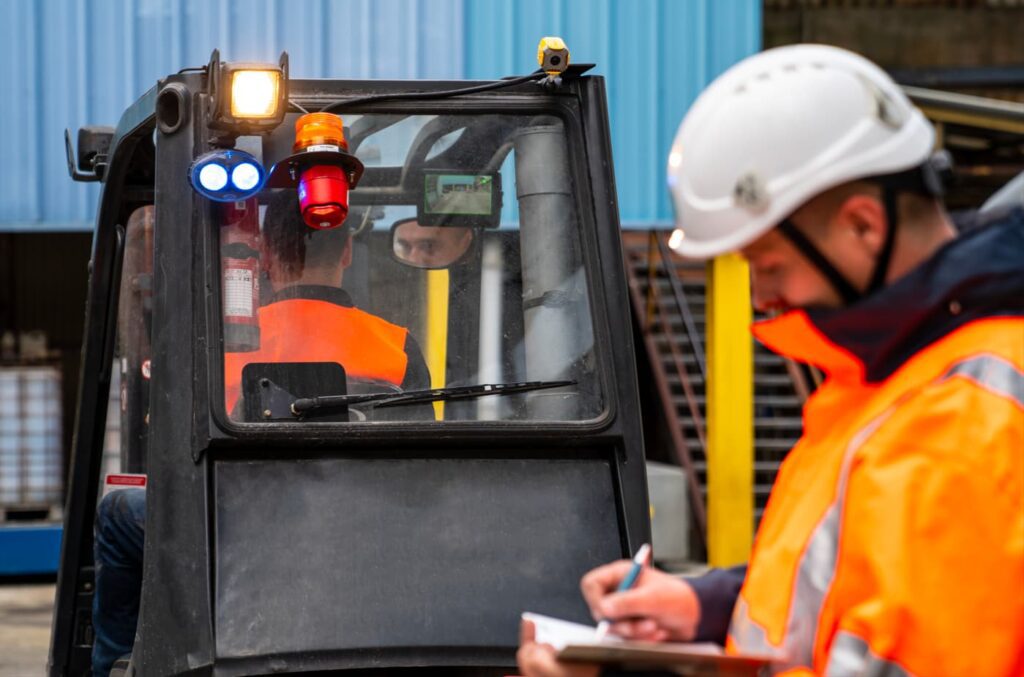
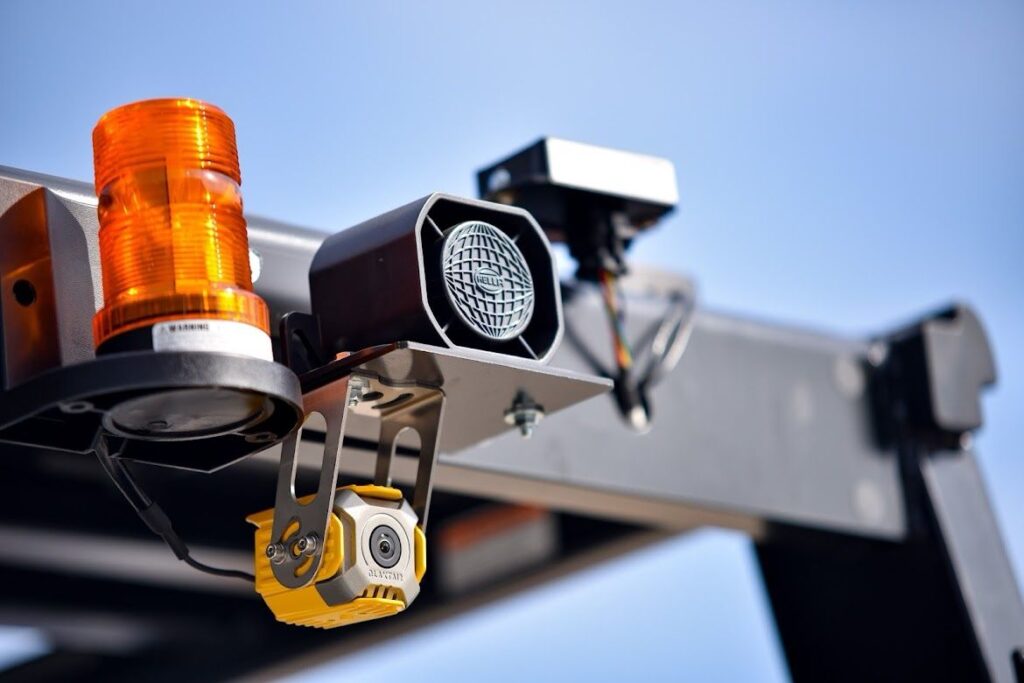
Its AI-powered camera systems can be installed on:
- Forklifts (electric or diesel)
- Wheel loaders and skid steers
- Excavators and telehandlers
- Haul trucks and specialty vehicles
Key retrofit advantages include:
- Brand-agnostic installation (no OEM dependency)
- Works on electric, hybrid, and combustion vehicles
- Operates as a standalone system or connects via Blaxtair Connect
- Proven reliability in dust, rain, vibration, and low-light conditions
By using computer vision and deep learning, Blaxtair detects pedestrians—not just objects, dramatically reducing false alarms compared to radar or ultrasonic systems.
The 5-Step Retrofit Framework for Safety Managers
1. Risk Zone Audit
Identify high-risk interaction zones by analyzing:
- Traffic density
- Blind spotsTra
- Pedestrian flow
- Historical near-miss data
Focus retrofit efforts where human–machine interaction is most frequent.
2. Machine Mapping
Create an asset inventory including:
- Vehicle type and model
- Operating environment (indoor/outdoor)
- Blind-spot profile
- Daily usage patterns
This allows consistent safety coverage across dissimilar machines.
3. Installation Planning
Define:
- Camera mounting positions
- Power supply access
- In-cab display placement
When operators trust alerts, compliance and reaction times improve.
4. Operator Training & System Tuning
Effective adoption requires:
- Hands-on operator training
- Clear explanation of alert logic
- Fine-tuning detection zones to real-world workflows
5. Performance Monitoring & Scaling
With connected options like Blaxtair Connect, safety managers can:
- Track detections and near-misses
- Identify recurring risk zones
- Support continuous improvement initiatives
Timeline and Cost: What to Expect
One of the biggest advantages of retrofitting safety systems—especially in mixed-brand fleets—is speed. Unlike machine replacement or OEM-only upgrades, retrofit projects are designed to fit into real-world operations with minimal disruption.
Typical Installation Timeline
- Average install time per vehicle: 8 hours
- No heavy mechanical modification required
- Can often be completed during planned maintenance windows
Most sites retrofit vehicles one at a time, allowing daily operations to continue without shutdowns or production losses.
Operational Impact
- Vehicles remain in service the same day
- No need to reconfigure fleet workflows
- Minimal learning curve for operators
Because Blaxtair systems are standalone and brand-agnostic, installations do not depend on OEM software access or proprietary vehicle electronics.
Retrofitting allows companies to extend the life of existing assets while bringing safety performance up to modern standards.
ROI Drivers
Safety managers typically justify retrofit projects through:
- Accident and near-miss reduction
- Lower repair and downtime costs
- Potential insurance premium impact
- Stronger regulatory compliance posture
In many cases, the system pays for itself by preventing a single serious incident.
Supported Machinery Types
A key requirement for mixed-fleet retrofitting is versatility. Blaxtair systems are designed to adapt to a wide range of industrial vehicles—indoors and outdoors, electric or diesel, compact or heavy-duty.
Commonly Retrofitted Vehicles Include:
- Forklifts
Counterbalance, reach trucks, warehouse forklifts - Wheel loaders & skid steers
Construction, quarry, and yard operations - Dumpers & haulers
Mining, quarrying, large industrial sites - Excavators & backhoes
High blind-spot risk, rotating equipment - Telehandlers
Construction and material handling environments - Tow tractors & airport tugs
Logistics hubs, airports, and industrial transport zones
Each machine type presents different blind-spot and interaction risks. Blaxtair’s AI camera configurations are adapted accordingly to maintain consistent pedestrian protection across the entire fleet, regardless of vehicle design or manufacturer.
Compliance, Insurance, and ROI Benefits
Retrofitting safety systems supports:
- OSHA-aligned hazard mitigation strategies
- Insurance risk reduction and premium discussions
- Stronger documentation for audits and investigations
Beyond compliance, most organizations see measurable ROI through:
- Fewer incidents and near-misses
- Reduced equipment damage
- Improved operator confidence and productivity
Retrofitting your mixed machinery fleet doesn’t have to be complex or disruptive.
Blaxtair helps you deploy AI-powered pedestrian detection across every vehicle, regardless of brand or age.
Request a demo to see how Blaxtair retrofits safety into your fleet—fast, reliably, and at scale.
FAQs
Can safety systems be retrofitted on older industrial vehicles?
Yes. Blaxtair systems are designed specifically for retrofit applications and do not require OEM integration or factory-installed electronics.
Do retrofit systems work across different brands?
Yes. Blaxtair is fully brand-agnostic and supports mixed-brand fleets without compatibility constraints.
How long does installation take?
Most installations are completed in a few hours per machine, depending on vehicle type and configuration.
Do retrofit systems generate many false alarms?
AI-based pedestrian detection significantly reduces false alarms by distinguishing people from objects—unlike radar or ultrasonic systems.
Can retrofit systems connect to fleet management platforms?
Yes. Blaxtair Connect enables data reporting, analytics, and integration into broader safety or fleet strategies.