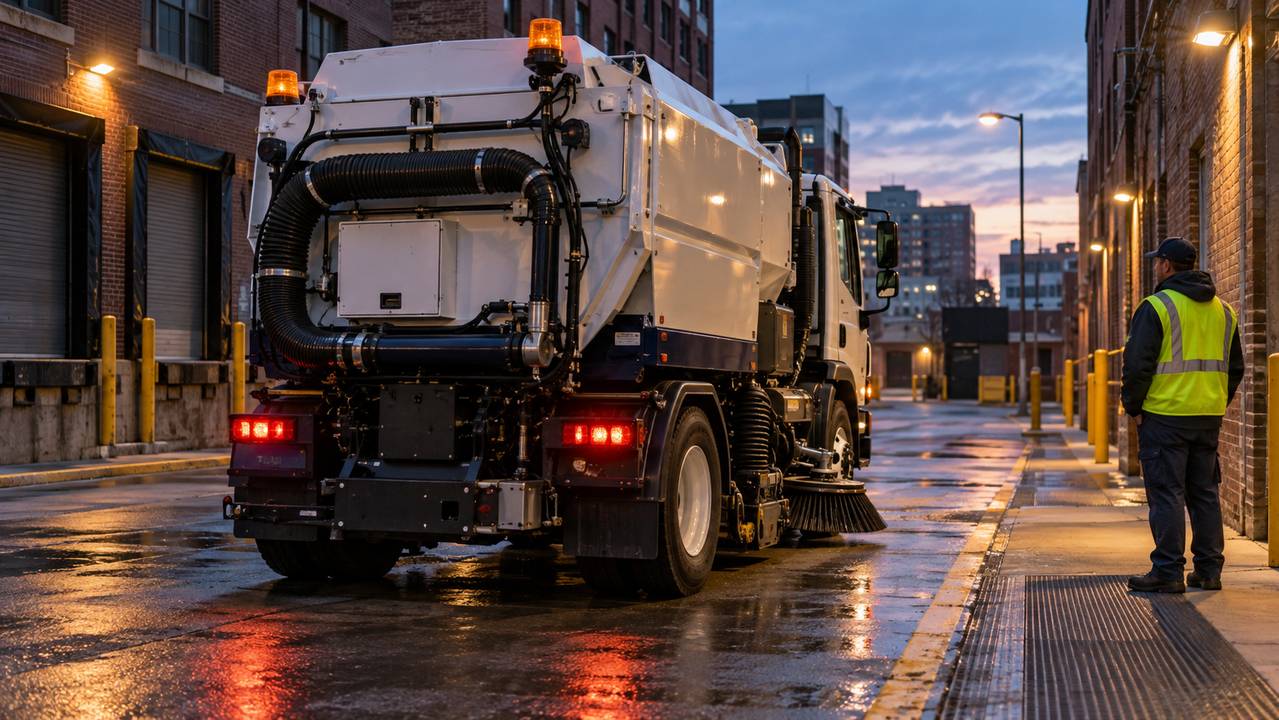
AI Pedestrian Detection for Street Sweepers: Safer Urban Operations
Street sweeper safety depends on recognizing people while managing brushes, traffic, and tight curbside clearances. Early starts and night shifts add visibility challenges. AI pedestrian detection provides an additional warning layer, helping operators respond to people in monitored blind zones and giving municipal fleet managers evidence to guide prevention.
Why street sweepers face unique pedestrian safety risks
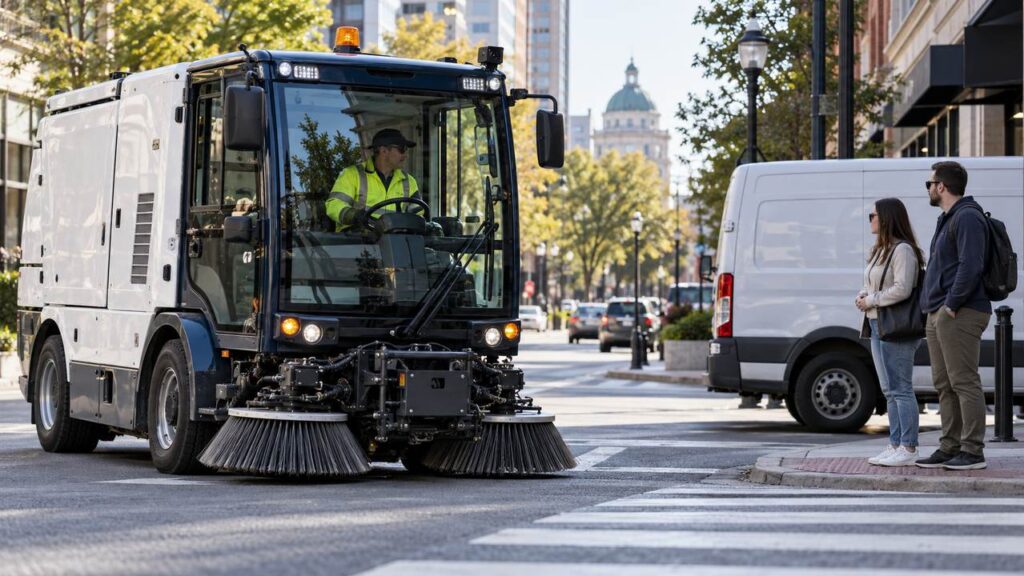
Sweepers work beside sidewalks, crosswalks, and bus stops where pedestrian movements change quickly. Slow-speed creeping still creates exposure. Brushes, suction, and traffic compete for attention, while vehicle bodywork and parked cars restrict sightlines. Streetlight glare can further complicate early-morning and nighttime operations.
The most common collision and near-miss scenarios
Kerbside sweeping next to parked vehicles
On an illustrative downtown route, a parked van conceals someone approaching a crossing. The operator may see the person only when they emerge. Cameras cannot see through the van either.
Reversing in alleys, cul-de-sacs, and loading zones
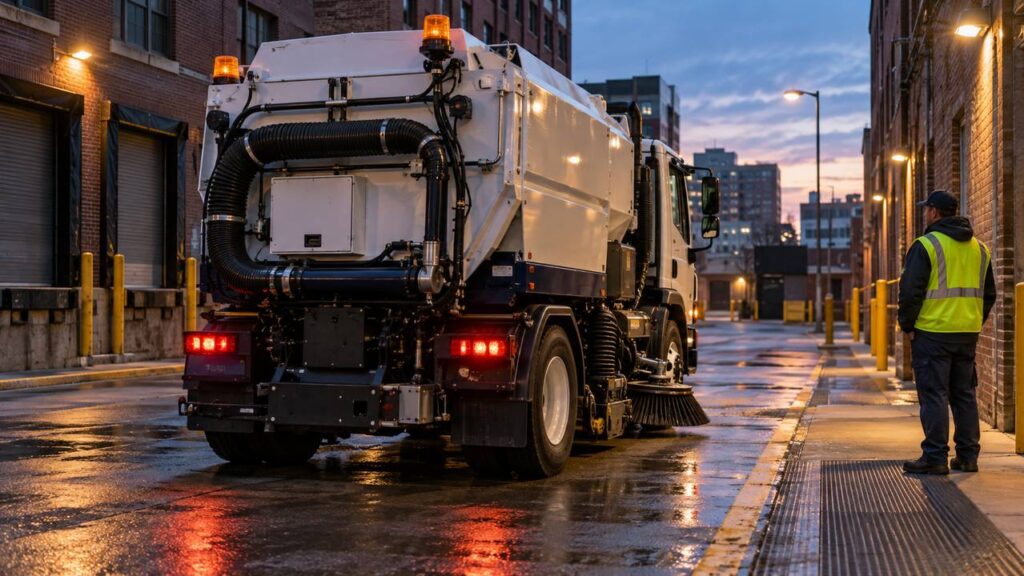
Restricted turning space and rear visibility bring workers and pedestrians close to reversing equipment. Establish a clear maneuvering area and agreed spotter signals.
Intersections and pedestrian crossings
People may change direction while cyclists approach from another angle. Evaluate these encounters separately: pedestrian recognition does not automatically establish cyclist detection performance.
Work teams on-foot around the sweeper
Spotters, maintenance personnel, and cleaning crews can move into blind zones. Confirm their positions before moving; detection never replaces safe maintenance procedures.
Why traditional safety controls often fail in real city conditions
Mirrors and cameras require attention during demanding tasks. Audible alarms can blend into city noise. Spotters need clear communication and can tire; staffing every maneuver is impractical. Generic proximity sensors may repeatedly warn about bins or parked cars.
These controls remain essential. NIOSH recommends procedures and controls for backing operations. Apply route risk assessments, speed management, pedestrian separation where feasible, and work-zone procedures alongside technology.
How AI pedestrian detection improves street sweeper safety
Real-time human recognition in operational blind zones
AI analyzes camera images to identify people within configured detection zones. Blaxtair Pedestrian Detection recognizes and locates pedestrians, including partially visible people, subject to installation and operating conditions. Full occlusion remains a limitation.
Fewer nuisance alerts to preserve operator trust
Human recognition can reduce warnings triggered by nonhuman objects such as posts and bins. Measure nuisance alerts during testing; do not assume every alert is relevant or every person is detected.
In-cab warnings designed for operator decision-making
Warnings should be understandable above sweeper noise without drawing attention away from traffic. Train operators on the expected response. An alert system does not imply automatic braking.
Adaptable to different routes and duty cycles
Validate detection zones for downtown sidewalks and residential night routes. Confirm configuration options with the supplier, test glare and low light, and include lens cleanliness in pre-start checks using Blaxtair Checklist where compatible.
The broader benefits municipalities and contractors care about
Preventing incidents can reduce liability exposure, claims, equipment damage, and service disruption. These are potential benefits, not guaranteed savings. Blaxtair Connect® offers detection statistics and hotspot mapping to support preventive action. Confirm reporting availability for the proposed installation.
Consistent requirements across municipal and contractor fleets strengthen governance. Documented corrective actions can support public confidence more credibly than unsupported accident-reduction promises.
30-day pilot plan for street sweeper fleets
Week 1: Route risk mapping + baseline
Choose two or three routes covering downtown, residential, and night work. Map schools, crossings, bus stops, and narrow streets. Record operating hours and existing near-miss reports. Brief operators and agree success criteria before installation.
Weeks 2–3: Deploy + measure
Track pedestrian alerts per operating hour, repeat hotspot locations and times, and weekly two-minute operator feedback. Compare manually reviewed incident and near-miss logs before and during deployment. Use the first stable instrumented period as the alert baseline.
Week 4: Optimize + rollout decision
Review events, tune zones, and update route procedures. Retest after changes; agree rollout scope and training.
How we measure impact: Divide alerts by monitored operating hours; compare matched routes and shifts. Record hotspot events per route pass and operator acceptance on a 1–5 scale. Log configuration changes and missing data. Fewer alerts can reflect lower exposure, reduced coverage, or downtime; 30 days cannot establish collision reduction.
What we recommend in practice: Map routes, brief operators, review pilot KPIs weekly, and assign an owner to each corrective action.
Data integrity: Define event timestamps, access roles, retention, and audit retrieval before collecting data. Verify available exports and location accuracy; restrict identifiable images to authorized purposes.
Buyer checklist: what to demand from AI pedestrian detection on street sweepers
- Human recognition demonstrated on representative routes
- Tested low-light and glare performance, with limitations documented
- Configurable zones matched to vehicle geometry and operating conditions
- Clear in-cab warnings accepted by operators
- Retrievable logs, reports, and consistently defined KPIs
- Retrofit assessment covering mixed fleets, mounting, power, cleaning, and maintenance
Conclusion
Public works vehicle safety improves when technology supports disciplined operations. AI pedestrian detection adds timely warnings; a measured pilot establishes whether the installation meets municipal fleet safety needs.
Request a street sweeper risk assessment and pilot plan. Share vehicle models, routes, and shifts to discuss coverage, deliverables, and success criteria with Blaxtair.
FAQs
What is street sweeper pedestrian detection?
It identifies pedestrians near a sweeper, especially in monitored blind zones, and warns operators during curbside or reversing operations to help prevent collisions.
How does AI pedestrian detection reduce false alarms in cities?
It distinguishes people from nearby objects, reducing warnings from street furniture and parked vehicles. Actual performance depends on conditions and configuration.
Can AI pedestrian detection be retrofitted to existing street sweepers?
Often, yes. A technical assessment must confirm mounting, power, camera coverage, and compatibility for each model before extending the system across a mixed fleet.